
The Year 2023, Common Era
Hi there, I mean, Hello, world. I have returned to blogging.
In this, the year: 2023. At the end.
I don’t have any thoughts about it at the moment that I’d like to share; I’m in the middle of a backup proj I want to get finished. But I felt it must be noted that 2023 just looks so good as a set of numbers. I’m sad to see it go.
That’s all for now.
2020-2021
Just a quick note here to cap things off, might return to blogging but I want to work on other projects. Like a podcast. Gave up on year end lists a while ago, you may have noticed. It was a good way to organize my thoughts, when my thoughts were mostly about new music releases. Though I still have a passion for music, my opinion on whatever just came out or streaming format wars or whatever whatever—just doesn’t seem that important. And the people agree; these posts have never really gotten a lot of comments, maybe none. That’s fine. I can just forget about it and go back to what this blog has always been about, reviewing records.
How many notes are there?
Here’s another video by someone else. Maybe I should make videos at some point. Sorry if I keep going over the same material but no one really seems to be paying attention, I’m just ironing out the concept more and more. Hopefully.
How many keys are there?
Here’s a clip of Victor Wooten explaining a very basic concept of music theory that is not always explained so simply. The answer you get is easy once you know, but it’s not the intuitive answer. Even he got it wrong at first. Why? Because in traditional music theory there are 6 keys that overlap:
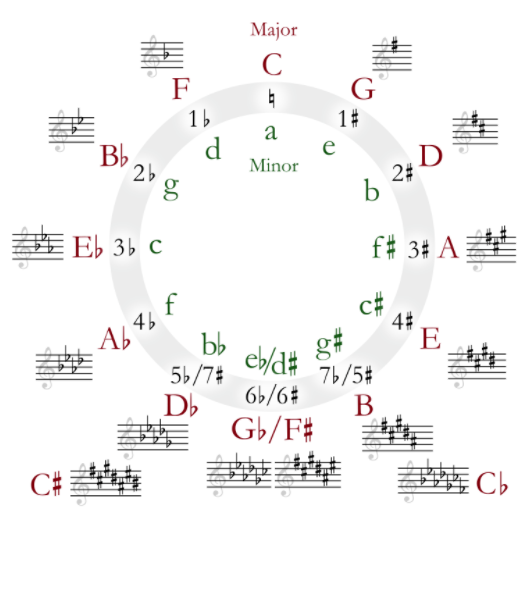
(this image from the circle of fifths wiki does not even bother to name a♯ and a♭ which is…interesting)
These keys, disregarding the sharp/flat system, contain the same notes. Sure, if you are intentionally doing something clever with modulation in a piece, like going around the Circle, you would never go from E to C♭ in your head or on paper, but the sound is no different in equal temperament. (Just noticed I’ve been spelling “temperament” wrong for as long as I’ve been using it. Never heard the “a” pronounced, that’s something new.)
This matters (to me) because as I’ve said in the previous posts, there’s nothing inherently “natural” to the “natural note”. There’s only the note you start on and the intervals. Take the point that modes are not keys but scales. If you are playing in C, you can start playing a C scale melody but let’s say you switch to playing the Dorian mode. The key hasn’t changed, you are still playing entirely on the white keys, but the tonal center has, and the intervals of the scale have. That’s a difference you can hear. There’s a game you can play with traditional music theory that I’ve come to appreciate more than dismiss the more I get into it, but the average person (non-musicians; people without perfect pitch) really are never going to. That’s fine but it’s not the thing I’m interested in. Hopefully I can spend more time on interesting things in the future.
Gamelan & Sonic Youth
In many ancient traditions and contemporary settings, music is not written out for the performance. It’s worked out among the musicians, maybe by a lead composer type all at once, or by the group over a period of time. The piece or song is memorized and maybe at some point has a life outside that group of musicians, so it becomes like an oral tradition of storytelling.
So, let’s say you wanna write that down. Seems reasonable that you’d try to do this with the tools you have, which is staff notation invented for western orchestral music. But unless the musicians in question were also trained in this method and set out to follow the rules as such, you are going to end up with a crude approximation. Two examples I’ve been really interested in over the years is traditional Balinese Gamelan and the 80s-90s work of punk/art rock group Sonic Youth.
Worth noting that Gamelan music has a native written form (a few in fact), and that the harmonic ideas of SY have roots in the music of avant garde composer Glenn Branca, who has his own presumably meticulous system. But in practice, both of these types are just winging it. In addition to not adhering to a preexisting written standard, they also both are using either bespoke or customized instruments and tunings. (Really hate the use of “bespoke” to mean “custom” but it fits here.) A Gamelan orchestra—all the gongs and metallophones—are made as a piece, tuned to itself. Each player isn’t bringing the reyong or gangsa they are leasing from Guitar Center, these things only exist together as one thing and can’t be individually adjusted. If one were lost or broken, you can’t even swap one out from another group. Likewise, when SY’s van was stolen in 1999, the sound of the band was heavily impacted. They were touring with 24 heavily customized guitars; almost a different set for each song. All of the older songs from that point had to be reworked and relearned.
Here’s the most comprehensive list of SY tunings, which, despite appearing to be a fan site in design and guesswork is in fact their official site. The band themselves apparently did not keep exact notes and any 3rd party’s detective could be just as good. I have even seen versions that note differences in the unison tunings (i.e. “second D slightly flatter”) and this is where a decimal system of tuning would really be helpful.
It’s these slight differences that create a sound totally different than what can be achieved through normal western intonation. The shimmering textures most…notable…here are created very deliberately (tho not always exactly or uniformly) by the dissonances that are reduced or edited out completely of regular music.
The very complex numbers that you can wind up with when referring to a note by it’s frequency in Hz can be replaced with a simple “𝑥.𝑥𝑥” by using the 0-11 formula and then the deviation .01-.99 in cents, ultimately leading one to a very snappy conclusion.
繕った [records tumblr]


Visitors
Recent Comments