
Morning Musume | Rainbow 7
The following is a repost from my old blog. This past year held the tragic news that producer Tsunku got throat cancer and had his vocal cords removed. Altho I haven’t been a fan of the direction of the group since the late 00s, I still love the old records and if you count yourself as a fan of the music and are not saddened by this event, you are a horrible person and deserve to fail at every stupid thing you do. This is definitely one of my strangest and most thorough reviews and I’m going to try not to read it as much as possible before I change my mind. And now, an excuse to use the horizontal rule:
Needs Moar Tsunku
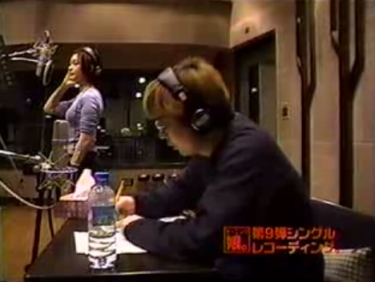
I was messing around the other day with hooking my boom box to my 8-track. Long story, but the point is the CDs got switched around. I cued up a track that I thought was going to something I recorded earlier. It was something else. But I didn’t place it right away. I was using a stereo cable into a mono input. It didn’t notice the mistake listening to my own recording because it was in mono. But now I was only hearing half the song. The hilarious half? Maybe.
It was Rainbow 7.
Yes, you can do this digitally. It might even sound a little better. But I never had a reason to try. And I’m sure other people have noticed this, slowly taken off their headphones, closed their eyes, and tried to forget, tried to forget….
No, I have to post it. I think it’s cool. You can hear down into the mix, not just the backing voices (sometimes multiple Tsunkus or other backups), but there’s a lot going on that you just can barely hear in the full mix. They spent time putting in that in there. For me, that’s a lot of the greatness of it. If you have not heard this music at all, this is not a good place to start. If you have and not really gotten why I keep going on about it, maybe it helps. Maybe it seems even dumber. But I don’t think so. I can’t make you like it, but maybe I can get you to respect the process of it? RE-SPECT.
If you have to this point successfully denied the presence of “the voice”, or have some mental method of blocking it out, maybe don’t ruin it. Some things cannot be unheard.
Music is Not Math
It’s this thing again.
You may be new. I’ve got this idea I’ve been working on a while. It’s supposed to make writing music more simple, so instead of expanding the idea with each post, I’m gonna recap the whole thing each time I come up with a better way to put it out there. Here goes:
Music is a language. It express pure emotion more than ideas. (Lyrics are not music, put that aside.) If you think of language as math, you are already likely a poor communicator, so for music it would be even worse. So, do not be confused by the use of numbers. Yeah, a computer program can write a song, who cares, not about that either. If you write a song in the traditional manner well enough, a computer program can also play it back it you, a fully programed feeling, if you like. Not so with this method. A computer could almost never get an accurate reading of a song written in this manner. (It would have to be a really terrible song.)
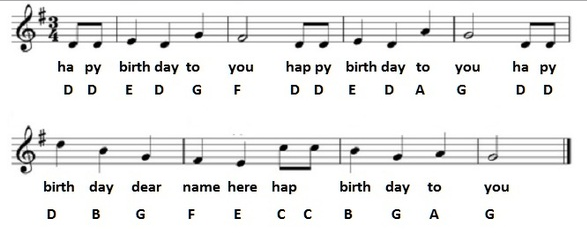
Let’s try it with one of the most terrible songs of all time, “Happy Birthday”. I hate it, but everyone knows it and it’s recently become public domain, so it’s perfect for this demo:
5 | 5 | 7 | 5 | 10 | 8
Hap- py Birth- day to you5 | 5 | 7 | 5 | 0 | 10
Hap- py Birth- day to you5 | 5 | 5 | 2 | 10 | 8 | 7
Hap- py Birth- day dear who zit3 | 3 | 2 | 10 | 0 | 10
Hap- py Birth- day to you
Now before you start worrying about the proper hyphenation of “Happy”, check out the third line. “Birth” is a higher note, isn’t it? It is, exactly an octave higher. You might want to mark that in some way. But you don’t have to.
If you want to get mathematical, which you might for a sound art installation or figuring out how to fix the acoustics of a room. That would involve real math involving putting notes into numbers and there is already a system for that, each key on a piano, for example, has it’s own soundwave frequency number. Musicians usually only think of the number they tune to, which is usually A440. But here are all the A’s on a grand piano:
3520 Hz
1760 Hz
880 Hz
440 Hz
220 Hz
110 Hz
55 Hz
27.5 Hz
This is quite nice and neat compared to pretty much every other note, which have a lot of decimals. (Only exception: C7/Double high C @ 2093.00hz.)
So what.
- no octaves, melody can be played by any instrument or singer
- no sharps and flats, every key equally easy to write in
- promotes wide interpretation/adjustment of the melody
Back later with how this makes transposition much easier, which I screwed up before. Check out all the posts but it’s a work in progress. Dankon.
%
Top 10 Videos of 2015
Yeah, so I last did this at the end of 2011. Just noticed that playlist the other day and it holds up pretty well and was fun to do. I didn’t pay that much attention to videos this year but I was stuck in a blizzard and going through other people’s lists; there was some stuff I’ve been checking out that was pretty “zeitgeisty”, I mean I’m just journaling my own experience pretty much but it seems dumb not to mention certain things at all, like Bowie and Kendrick. But also the artists that made my year-end list made some pretty extravagant vids that I totally missed. And there was one I just threw in. It was pretty easy. Here they are in an order I thought looked good:
%
新しい‥General Update for 2016
How ya doin’. In the interest of being a responsible webmaster, thought I’d throw out a what we used to call a “changelog”, a term I just googled to make sure because I guess it’s been a while since I’ve seen someone do that on their site. I still think it’s a good idea. I’m not changing much so this will be short but the recent projects are no longer that recent. So, did a screencap yesterday on my phone and I still think it looks good:
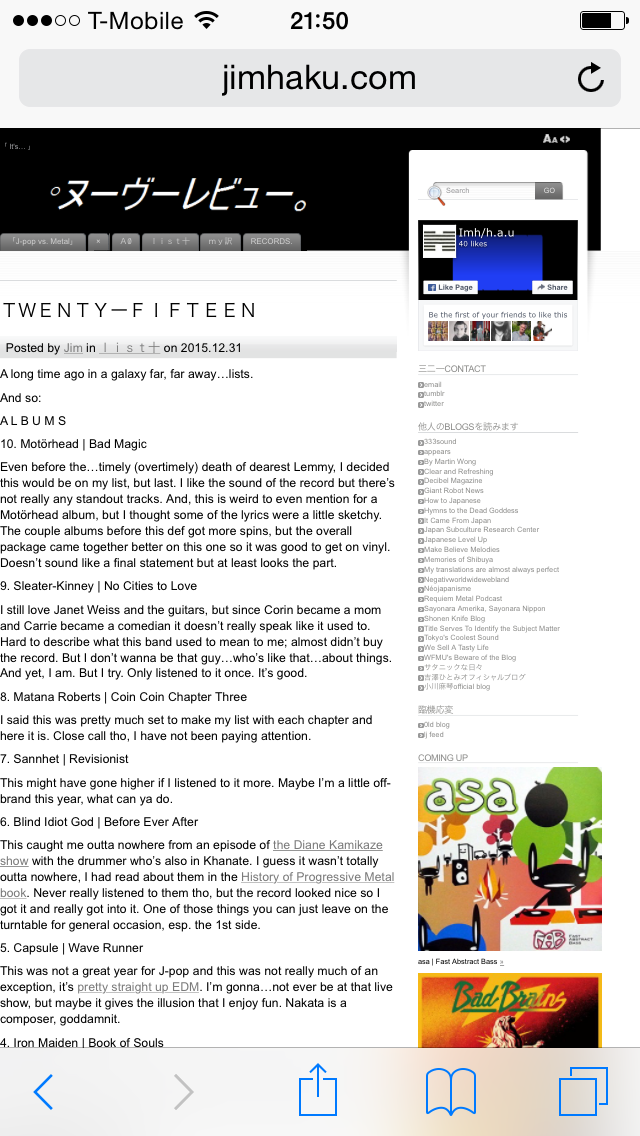
New WordPress updates offer responsive design and whatnot that make it easier to read on yr device, like tumblr does. I don’t care about that of course. I write a blog because I like blogs. You could say that what is now “old-school” blogging culture peaked around the time I started this one and “everyone” (“we”, ha) have moved on. Well, why not preserve an example of that peak? Sidebar…pisstake title…a fuckin’ Flag Counter…custom font, a footer with credits! Not saying I’m so great, but a merely shadow of greater blogs, nuked without a second thought. Look upon it and despair, or don’t, whatever.
Ch(x5)anges
- Links list gets shorter all the time. I will still link to inactive blogs, but I can’t have dead links on a front page. Sad to see some long-time projs go. (If you find links to old podcasts that are dead in any old posts, hmu, I probably have ’em saved.)
- Speaking of links and front pages, if you link to this blog, ya gotta have the www’s, or it’ll go to tumblr. Neat trick, right.
- Speaking of tumblr, I switched the urls on the two main tumblrs. I debated killing the 「IMH/H.A.U 」 thing altogether, as a name. It was at one point, sort of a record label. But the only people who really considered it that were last.fm, until they stopped doing that some time last year. I could start making CDRs again, or tapes. The only thing stopping me is total lack of demand. But I also used to use the name on mixtapes of whatever I was listening to, so there’s the music I’m listening to. I may review some of it.
- Speaking of speaking, I went through my own old podcasts, separated the better ones (that had a few good moments) from the ones that no one needs to hear again into another folder, deleted the folder, then shredded the recycle bin at the maximum setting. The wrong folder of course. Hmu, you probably have ’em saved. (You don’t.)
- Anyway, I appeared on the Abstract Japan podcast, talking about J-pop vs. Metal. I could continue the podcast or not, I’m happy enough with it as a done thing but I’m pretty bummed about the site right now cause a lot of the videos are not available in America. I’m hoping this will get resolved soon. Even tho it’s really just a tumblr it’s meant to be something you can go through like a book, not just a hose of “content” to be monetized or whatever. (CD Japan never even signed me up for the affiliate program btw, they didn’t get it. “Not enough content.” But I still buy from them, when I can…who knows how long that will last, we live in a harsh and disturbing universe where change cannot really be controlled, and I actually have server bills to pay…) But enough about me.
%
繕った [records tumblr]

Visitors
Recent Comments