
Shonen Knife | S/t
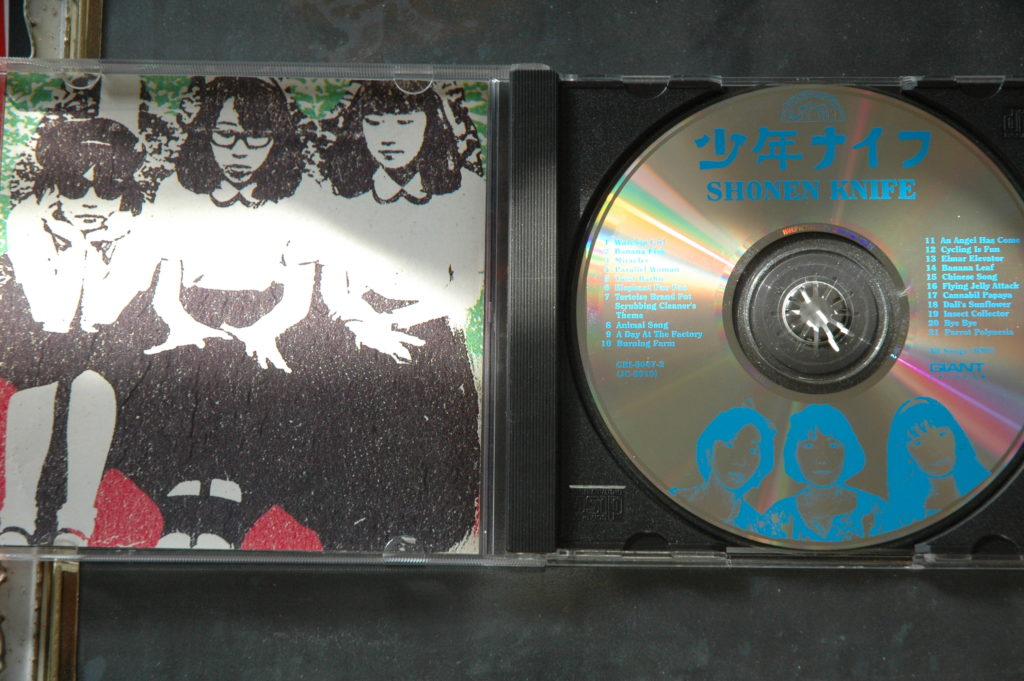
Shonen Knife Day. They got a new record out. I don’t have it yet. Next paycheck. But time marches on, and with so many horrible things in the world, there’s this band. It’s maybe kinda dumb that there is a Shonen Knife Day. I didn’t say that. Did you say that? I’m glad there’s an excuse to write about them just now, myself. And listen to the album. I’m gonna listen to the album, then write about it, that’s the order of things that I will be doing. Then maybe I’ll listen to it again but that doesn’t concern you.
This is not strictly a real album released by the band. It compiles their first two albums from the early eighties on Zero Records, Burning Farm and Yama-no Attchan and also includes tracks from the Zero comp Aura Music. Apparently these tracks are on the reissue of Burning Farm as well as the K Records cassette so maybe this is too much information. I’ve never bothered getting these other more official versions, but I’ve heard them and they just don’t seem as good to me. I mean the sound quality’s probably better, but I just love how this thing is sequenced. It really feels like one long album; it’s the definitive early history imo. It’s not like breaking up the two albums restores some kind of distinct conceptual arcs, they are just collections of songs they had at the time. And the level of songwriting and recording had yet to progress so it all matches. (They have a technically have a demo album before all this but that is really raw and not that great to listen to.)
The members of the band themselves may disagree but the recordings as they appear on this release are perfect. (They even re-recorded Dali’s Sunflower, I love that one in particular. Maybe there’s a guest on it they can’t credit?) It’s not exactly an Albini-type puritan affair of strictly live recordings, there’s some studio experimentation and sound effects thrown in here and there, but it accurately records (unless it doesn’t, I wasn’t there) what the band was at the time, which is what any band starting out should strive for. Altho I admit when I first heard it I was shocked at the difference in sound from the very modern Rock Animals and polished surf-punk of Let’s Knife, it grew on me pretty fast. It’s like instant nostalgia for something I never experienced before, there’s just a weird mood to it. Right from the version of Watchin’ Girl that sounds like the tape is changing speeds. It’s just as good as the later version but for different, unexplainable reasons. And I could be remembering this wrong, but I think it’s the first album I heard that’s all in Japanese. I remember falling in love with the sound of the language. It has a certain unique rhythm. Supposedly they prefer singing in English because all of their influences do, but before they learned English, they found it way to make their native language fit naturally in this early punk/pop soundscape. (Unusual song topics may have helped.)
Plenty has been written on Shonen Knife’s song topics, but what about that early soundscape? Ramones and Buzzcocks are the obvious precursors whose influence is carried on more or less to today. But here there’s the trebly, minimalist sound of the late-70s girl post-punk like Delta 5, Kleenex/LiLiPUT, maybe even The Slits. There’s an unmistakable reggae vibe to several of the songs which they really never went back to. In their book Shonen Knife Land they each have a top 20 albums list and the closest thing mentioned is a Beat Happening’s You Turn Me On, which is really not that close! That was from departed bassist Michie’s list and I talked about her contribution to the band before. But Naoko tries a lot of weird stuff too on this record: the cartoon industrial of A Day at the Factory, the tribal jam of Burning Farm, the melancholic Bye Bye—obvious album closer that ends Yamo-no Attchan, but the tacked-on Parrot Polynesia with its upbeat island vibe is an even better way to sign off. Seems totally planned.)
A whole generation of SK fans now is probably not familiar with the old stuff and/or just listens to streams and doesn’t care so much about the feel of an album. You are objectively wrong, first of all, that whole system is on it’s way to crashing and burning and does not care about you. Second—there is no second, this is their best early album and you need to listen to all of it.
%
HALCALI | Cyborg Oretachi
Over a goddamn year ago, mbmelodies called my bluff to republish my old Halcali posts. This was right before I decided to upgrade my blog security and I wound up locking myself out of the blog for most of 2015. So I’ve only really been putting it off for 5…6 months. Sure, that sucks. And so do almost all of my old blog posts. Not that I’ve really gotten “good”, but you can kind of understand what I’m getting at most of the time now, I think. I mean that I do not understand most of my old blog. It’s mostly references to deservedly momentary jokes, fed into a literally drunken, figuratively surrealist filter which was never cleaned, and finally clogged. But here is a review of the 3rd Halcali album. It’s pretty silly, and my opinion of the album is not quite as high—the first 2 albums hold up a lot better and will get whole new reviews—but it’s still worth checking out again, or the first time, what have you. Except the album and single mix of “Twinkle Star” are indeed completely identical, I think I just got new headphones at that point. Who knows, anyway here it is with all the broken links and everything:
Last Modified

2007/08/15
HALCALI | Epic Hits (and Misses) + More!
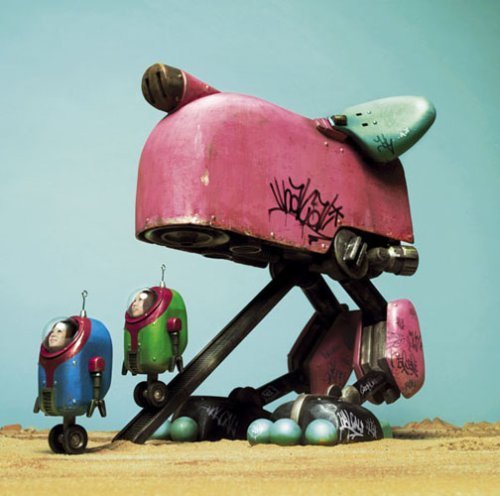
HALCALI | Cyborg Oretachi [Limited Edition w/ DVD]
[listing courtesy wiki.theppn]
1. Doo THE HAMMER!
2. It’s PARTY TIME!
3. Koi no Bububun (恋のブブブン; The Vroom Vroom Vroom of Love)*
4. Twinkle Star
5. endless lover’s rain
6. LOOK ~Special Edition~
7. Cyborg Oretachi (サイボーグ俺達; We, the Cyborgs)
8. Driver’s Licence (ドライバーズ・ライセンス)
9. Fes de Ouissu! (フェスでウィッス!)
10. Tougenkyo (桃源郷; Paradise)
11. Tip Taps Tip
12. HaruKari Michi ~19 no Yoru~ (春狩道~19の夜~; Halcali Road ~19 Nights~)
If you are a HALCALI fan, there’s good news and bad news.
Good news: Halcali has made the Album of the Year.
Bad news: The year is 2006.
Read the rest of this entry »
Music Might Require Some Math
In my most recent and more catchily-entitled post on numerical notation, I made the earth-shattering claim that a thing is not another thing. Now, let’s take things a step forward into what should be even more obvious territory, but remember, this is for musicians who are often really, really dumb. I believe—I must believe—that we, as a people, can become less dumb. Has traditional music notation made us dumb? Maybe?
Since starting this project, I’ve actually gained respect for traditional notation. It does have its own internal logic and it’s not that I’ve hated it all this time, I just wish I was better with it. It’s very much like religion. If you can come to accept a few made-up things out of nowhere as unshakeable facts, you can build a whole system around that which makes a kind of sense. If the alternative is total chaos, why not go with something that works. Make it a tradition, and after a few hundred years, no one even knows how to question it. It’s just the way things are.
Except…that is dumb. And just as it’s important to question established intuitions and practices, it’s important to question yourself; your blog postings. Where are they going? Wasn’t this sort of sprawling nonsense supposed to be avoided? Was it? Is it nonsense? I think it’s getting there. Almost there. OK then.
It’s more like “Music Works Better With Math” or “Music Is Easier with Math” but neither of these is good a title. It’s just not believable and it doesn’t give me room for an introductory segue that isn’t trying to convince you that math is fun. It is not.
“Music Might Require Math” is literally true in regards to soundwave frequencies, no matter what notation system you use, especially when you record. I’m gonna try to build on that basic truth, even tho for the playing musician, it’s more something that’s good to know than necessary. Like learning word origins isn’t necessary to communicate in a language, or learning programming isn’t necessary to write a blog. Here’s a video to break things up:
(Incidentally I use basic knowledge of ratios and html to alter the embed code to fit on the page better. It is not important for you to know this, but it is something that is possible to do.)
I recommend the books Understanding Records, How Music Works, and the lecture series How Music and Mathematics Relate from The Great Courses. (Wait for it to be on sale maybe. You can get the d/l cheaper.)
But I have a more practical application that only involves simple addition and subtraction. During the process of explaining the system, I’ve found out it is not that unique (or popular). This would be a good point for a normal person to stop spending time on an idea that basically already exists and that hardly anyone uses. So I put even more time into it because I felt there was still something else to it. There is another idea here.
It involves using the 7-string as the basic teaching instrument. (They are quite affordable now. ESP makes a decent one.)
Now, there’s two types of people that learn music, and this can appeal to both. There’s the analytical person and they tend to start learning on the piano and they can just learn the Circle of Fifths and all that and it just makes sense, they just internalize it, they are probably good at higher maths, in fact they probably just got into music (through parental pressure or not) as a kind of mind hack or way to be more well-rounded or interesting before they enter the relatively boring but highly-paid “real job” field. And then there’s the intuitive people, who pick whatever instrument seems cool to them and have to learn the rules (if they bother) through brute force repetition.
I don’t know if I need to tell you but I am the second kind. I spent most of my time learning music on the alto sax, which is in the key of E♭. I also played clarinet and soprano sax at some point which are in B♭. Altho I can tell you this, the entire time I played those instruments I would have a really hard time telling what concert note I was playing at any given time. I just took the whole transposition thing on faith. Really only figured out this easy way recently.
The alto sax sounds a major sixth lower than written (which I have to look up every time). In traditional notation, it’s an important distinction that it is transposing to a lower note. But if we throw out octaves, the difference is three units of measure (half-steps) higher:
written notes:
C D E F G A B C
3 5 7 8 10 0 2 3
sounded notes:
E♭ F G A♭ B♭ C D E♭
6 8 10 11 1 3 5 6
…and you just know it is the lower octave because it sounds lower. You could subtract the major sixth (9 units) with the same result of course. But I would leave that to the analytical people. I hope that this could possibly make music more of a creative option for them rather than a skill to master. Nobody learns Latin so they write poems in Latin, right? I’ve compared music to language, but really it’s a language that you can only write poems in. Using letters is a kind of pretension. It’s not a real language that conveys complex thoughts and facts. This is something that can be put onto the music (as lyrics, or titles), but it’s not really there in the notes themselves. Most of these people just learn the music of others, like you’d memorize a poem in a target language. But what if music is more like your native language of math?
The intuitive people have to be skeptical at this point and have probably not even gotten this far but now that the poseurs are gone, I can tell you The Real Shit.
Why a 7-string guitar?
Because when you tune it to major 3rds, the top strings are 2 octaves apart, just like a standard tuned guitar, but all the strings are an even interval apart. (Actually I first used this tuning on a 4-string bass. The important thing is to break the idea of sharps and flats inherent in learning on a keyboard, but it’s a lot easier to play chords on guitar. And maybe it makes people mad? Some people are still mad at the 7-string. It’s not so much a gimmick, but it gets their attention.)
Ok, here’s the tuning for the 7-string, right:
4 8 0 4 8 0 4
I came up with this at first just so I had at least a pair of zeros. Tuning the bottom string to A (from B) is not that low a tuning, but going by thirds, the top strings are way too floppy. Tuning the B string to F (in either direction) is obviously not an option. So I tuned the first two strings up, left the A string and tuned the rest down. (I’d like to maybe get custom strings for this at point, but it works well enough with the stock strings.) C#/D♭ (4) is not really the ideal lowest note. Would be better to go to C, yeah? Except it feels kinda right to me. So I get analytical on it. Turns out that Concert 4 is the lowest note on the alto, which I still think of as B♭. It’s just the way it worked out. But if you wanna get weird about it, it’s an option. Also the lowest note on the soprano is A♭/G# (11). Not planned, but maybe it’s subconscious. Personally I believe in coincidence and don’t trust anyone who doesn’t. But weird things happen. %
繕った [records tumblr]

Visitors
Recent Comments